
What Is a SaaS MVP and How Much Does It Cost to Build in 2026?
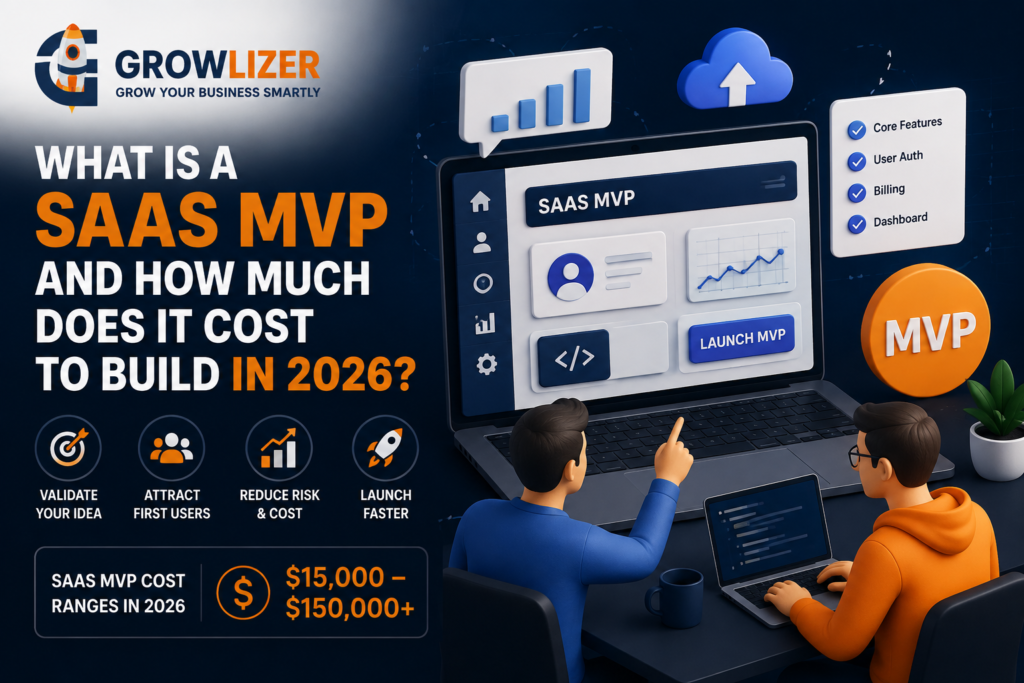
If you’re a founder in the USA, UK, or UAE trying to validate a software idea, you don’t need a fully built product on day one — you need an MVP (Minimum Viable Product). An MVP is the smallest working version of your SaaS that still solves the core problem for your first real users, without every feature you’ve dreamed up for version 3.0.
Why Start With an MVP Instead of the Full Product
Building the “complete” version of a SaaS product before testing it with real users is one of the most common ways founders burn through their budget. An MVP lets you:
– Validate that people will actually pay for the problem you’re solving
– Get real user feedback before committing to a full feature set
– Raise funding or reinvest revenue based on traction, not assumptions
– Launch in months, not a year or more
What a Typical SaaS MVP Includes
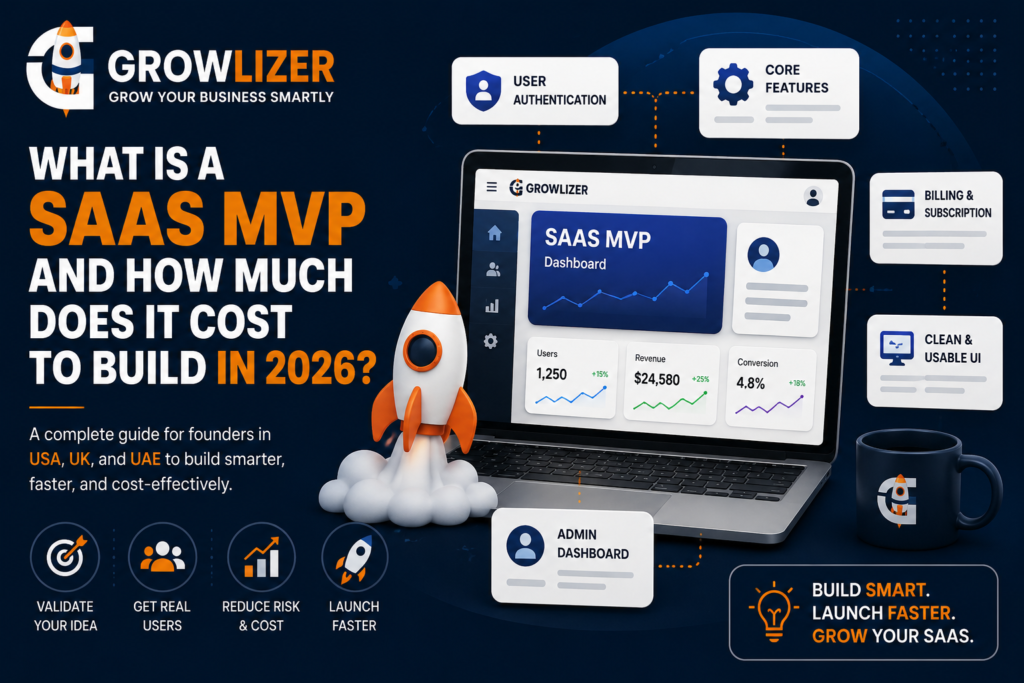
A well-scoped MVP usually covers:
1. User authentication — sign-up, login, password reset
2. Core feature set — the one or two things your product does that solve the actual problem
3. Basic billing/subscription — even a simple Stripe integration counts
4. A functional (not fancy) UI — clean, usable, not necessarily polished
5. Admin basics — enough for you to see what users are doing
What it should not include: advanced analytics dashboards, multi-language support, complex integrations, or every “nice to have” feature on your roadmap. Those come after you’ve proven people want the product.
SaaS MVP Cost Ranges in 2026
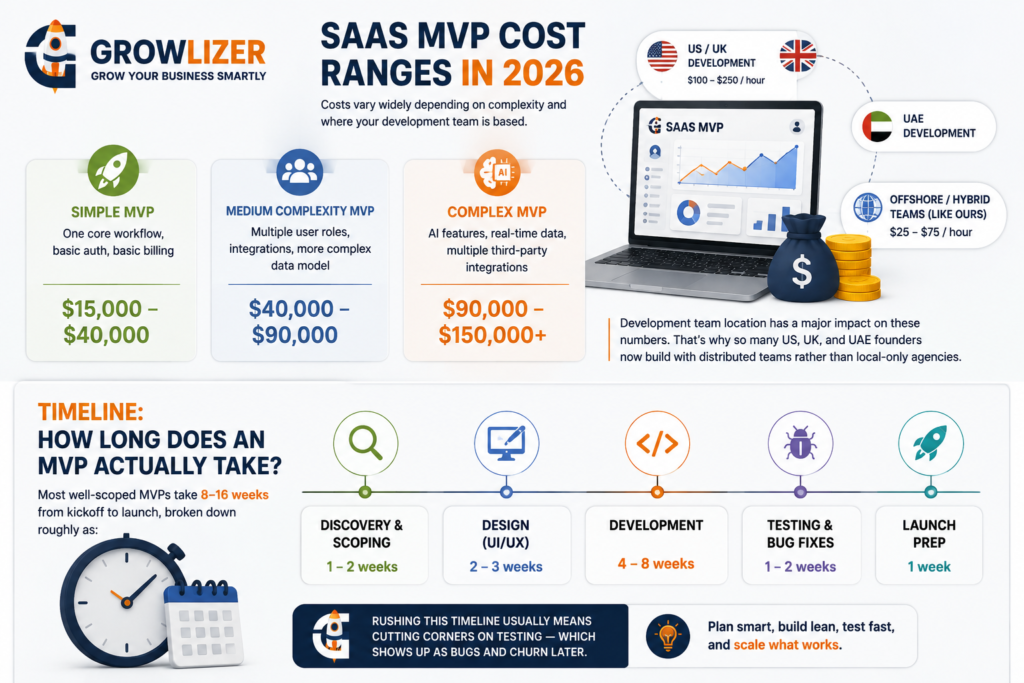
Costs vary widely depending on complexity and where your development team is based:
– Simple MVP (one core workflow, basic auth, basic billing): roughly $15,000–$40,000
– Medium complexity MVP (multiple user roles, integrations, more complex data model): roughly $40,000–$90,000
– Complex MVP (AI features, real-time data, multiple third-party integrations): $90,000–$150,000+
Development team location has a major impact on these numbers. In-house US or UK development typically runs $100–$250/hour, while offshore or hybrid teams (like ours) typically run $25–$75/hour for the same skill level — which is why so many US, UK, and UAE founders now build with distributed teams rather than local-only agencies.
Timeline: How Long Does an MVP Actually Take?
vMost well-scoped MVPs take **8–16 weeks** from kickoff to launch, broken down roughly as:
– Discovery & scoping: 1–2 weeks
– Design (UI/UX): 2–3 weeks
– Development: 4–8 weeks
– Testing & bug fixes: 1–2 weeks
– Launch prep: 1 week
Rushing this timeline usually means cutting corners on testing — which shows up as bugs and churn once real users arrive.
Common Mistakes That Inflate MVP Cost
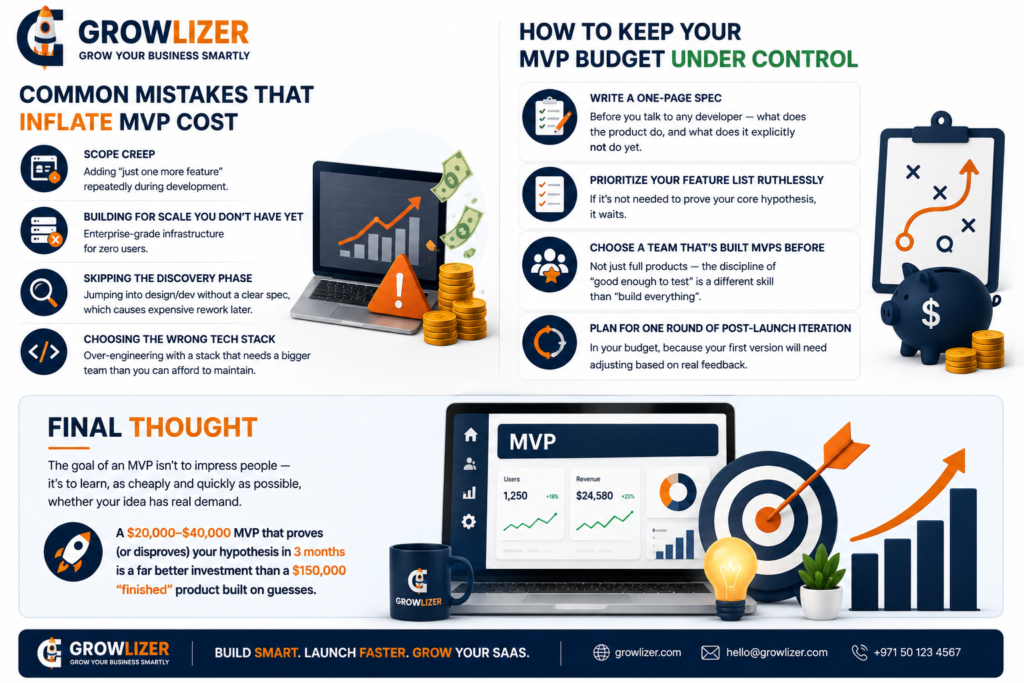
– Scope creep — adding “just one more feature” repeatedly during development
– Building for scale you don’t have yet — enterprise-grade infrastructure for zero users
– Skipping the discovery phase — jumping into design/dev without a clear spec, which causes expensive rework later
– Choosing the wrong tech stack — over-engineering with a stack that needs a bigger team than you can afford to maintain
How to Keep Your MVP Budget Under Control
– Write a one-page spec before you talk to any developer — what does the product do, and what does it explicitly *not* do yet
– Prioritize your feature list ruthlessly — if it’s not needed to prove your core hypothesis, it waits
– Choose a team that’s built MVPs before, not just full products — the discipline of “good enough to test” is a different skill than “build everything”
– Plan for one round of post-launch iteration in your budget, because your first version will need adjusting based on real feedback
Final Thought
The goal of an MVP isn’t to impress people — it’s to learn, as cheaply and quickly as possible, whether your idea has real demand. A $20,000–$40,000 MVP that proves (or disproves) your hypothesis in 3 months is a far better investment than a $150,000 “finished” product built on guesses.
Growlizer builds SaaS MVPs for founders across the USA, UK, and UAE, combining custom development with our AI automation expertise. If you’re scoping a SaaS idea, we’re happy to give you a realistic cost and timeline estimate before you commit to anything.