
How AI Agents Are Transforming Small Business Operations in 2026
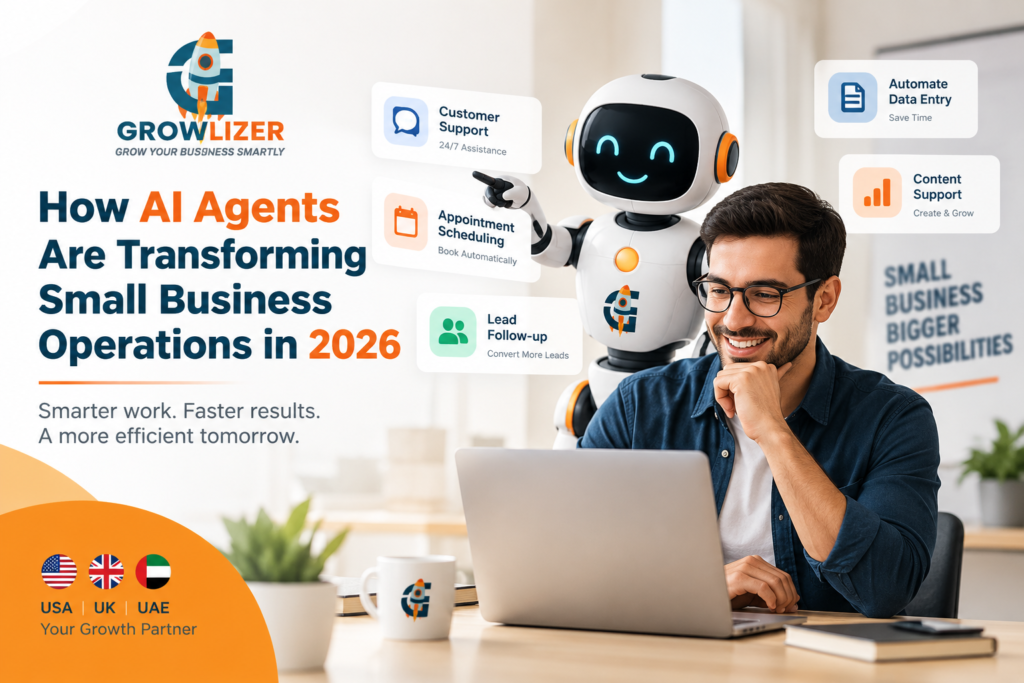
AI agents have moved past the hype phase. In 2026, small and mid-sized businesses across the USA, UK, and UAE aren’t just experimenting with AI chatbots anymore — they’re deploying AI agents that handle real, multi-step work: answering customer questions, qualifying leads, scheduling appointments, and following up automatically, without a human touching every step.
AI Agent vs. Chatbot: What’s the Difference
A traditional chatbot answers a question and stops. An AI agent can plan and carry out a sequence of actions on its own — checking a calendar, booking a slot, sending a confirmation email, and updating your CRM, all from one customer message, without a human relaying information between systems.
Where Small Businesses Are Actually Using AI Agents Right Now
The most common real-world use cases in 2026 aren’t flashy — they’re operational:
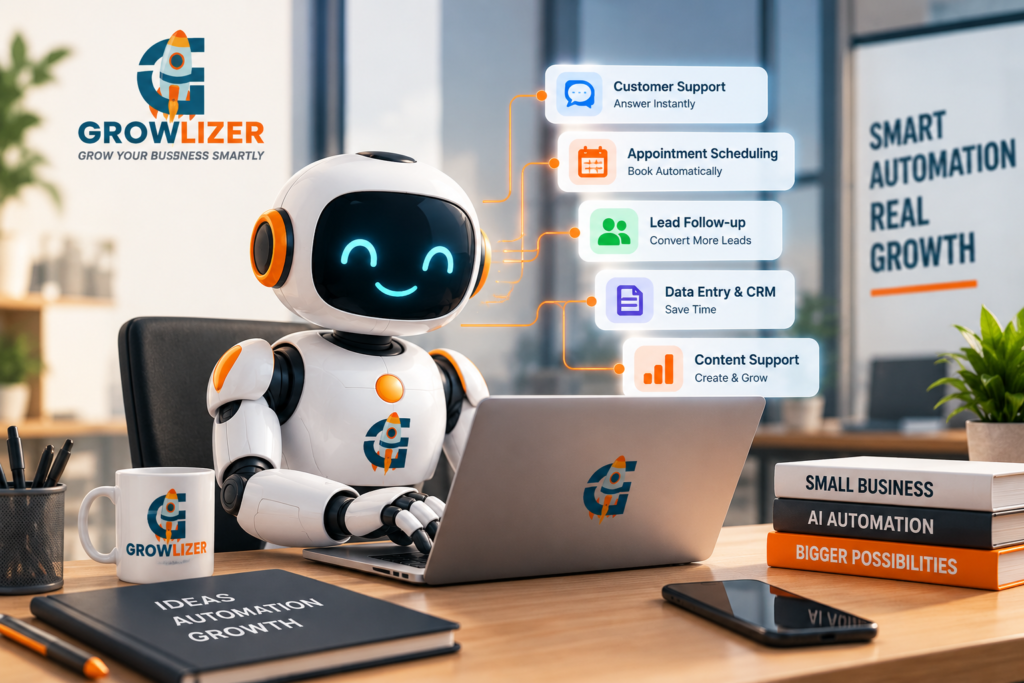
1. Customer service and FAQs — handling repetitive questions instantly, 24/7
2. Appointment scheduling — letting customers book, reschedule, or cancel without calling in
3. Lead qualification and follow-up — responding to new inquiries within minutes instead of hours, and following up automatically if a lead goes quiet
4. Data entry and admin automation — pulling information from forms, emails, or calls into your CRM or spreadsheets automatically
5. Content and social media support — drafting first-pass content that a human then reviews and approves
Adoption among small businesses has grown sharply in the last two years, with a meaningful share of small and mid-sized businesses now using some form of AI assistant or workflow automation for at least one of the functions above. The businesses seeing the clearest returns are the ones that pick one specific, repetitive workflow and automate that fully, rather than trying to “add AI everywhere” at once.
Why Speed Matters More Than You’d Think
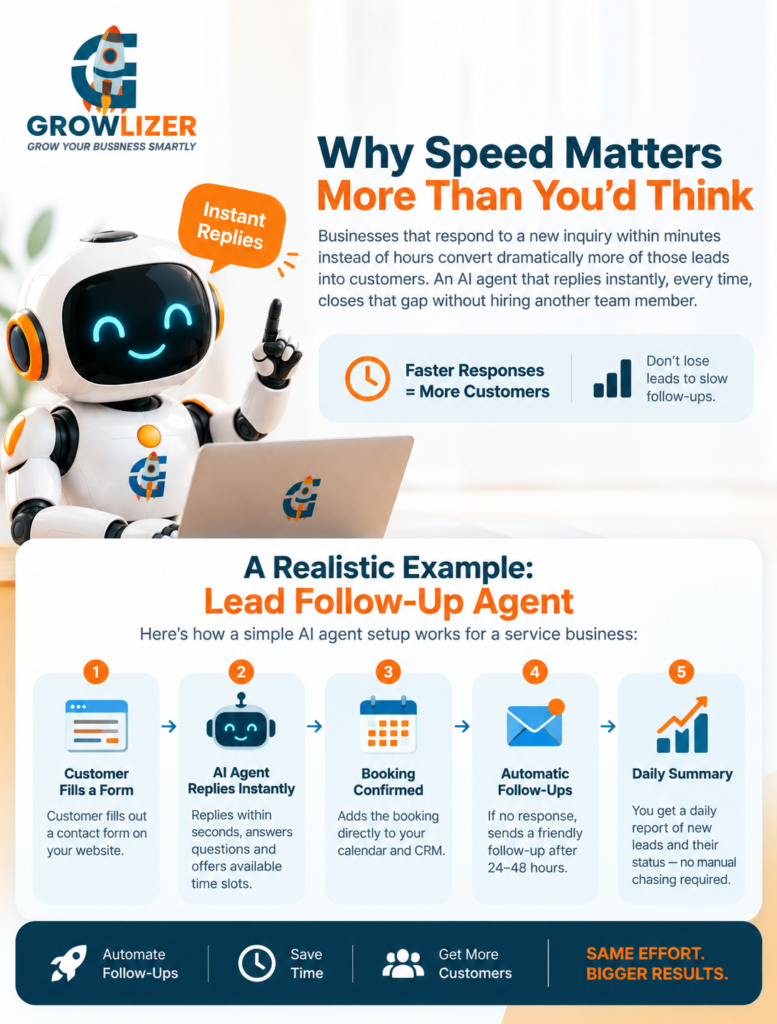
One of the biggest, most measurable wins from AI agents is response speed. Businesses that respond to a new inquiry within minutes instead of hours convert dramatically more of those leads into customers — a gap that’s been documented across industries for years, but that most businesses still don’t act on because manual follow-up simply can’t happen that fast. An AI agent that replies instantly, every time, closes that gap without hiring another team member.
A Realistic Example: Lead Follow-Up Agent
Here’s what a simple, high-ROI AI agent setup looks like for a service business:
1. Customer fills out a contact form on your website
2. AI agent replies within seconds, answers basic questions, and offers available time slots
3. If the customer books, it’s added directly to your calendar and CRM
4. If the customer doesn’t respond, the agent sends a friendly follow-up 24–48 hours later
5. You get a daily summary of new leads and their status — no manual chasing required
This kind of setup typically takes a few weeks to build and tune, and pays for itself quickly once you account for how many leads were previously lost to slow response times.
What AI Agents Are Not Good At (Yet)
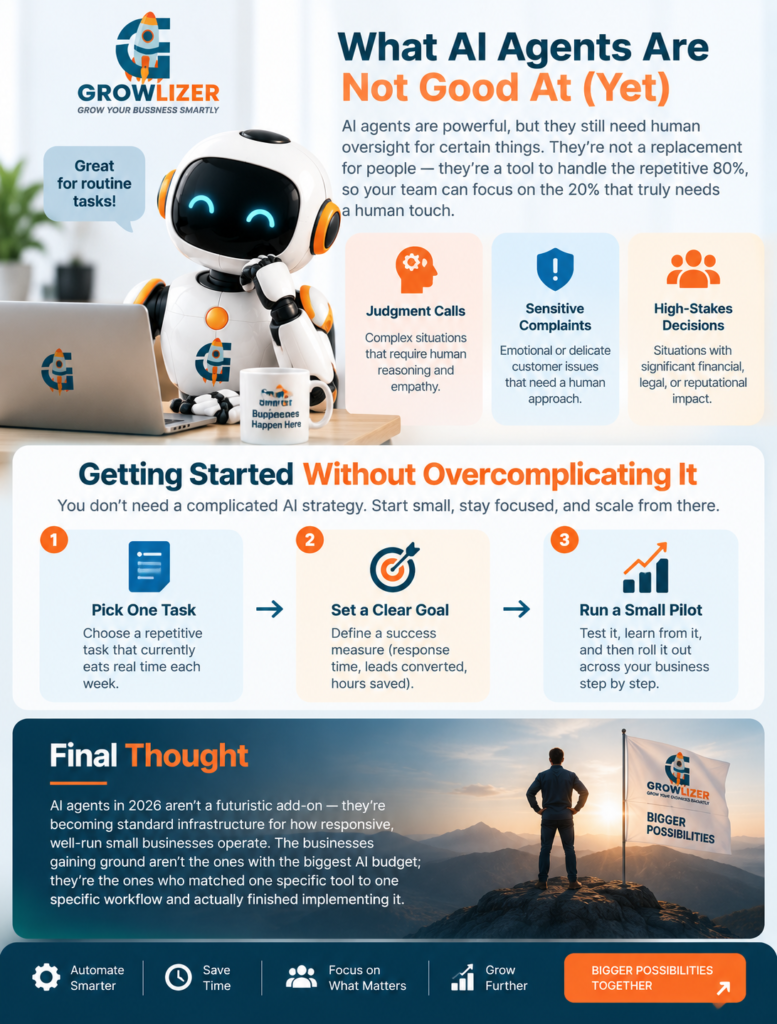
To set realistic expectations: AI agents still need human oversight for anything involving genuine judgment calls, sensitive complaints, or high-stakes decisions. The businesses that succeed with AI agents treat them as a way to handle the repetitive 80% of interactions instantly, freeing up humans for the 20% that actually needs a person.
Getting Started Without Overcomplicating It
You don’t need a company-wide AI strategy to benefit from this. Start with:
– One repetitive task that currently eats real time each week
– One clear success measure (response time, leads converted, hours saved)
– A small pilot before rolling it out across your whole operation
Final Thought
AI agents in 2026 aren’t a futuristic add-on — they’re becoming standard infrastructure for how responsive, well-run small businesses operate. The businesses gaining ground aren’t the ones with the biggest AI budget; they’re the ones who matched one specific tool to one specific workflow and actually finished implementing it.
Growlizer builds and deploys custom AI agents for small businesses across the USA, UK, and UAE — from lead follow-up to scheduling to customer service automation. If you have one workflow that’s eating your team’s time, we can scope what an AI agent for it would actually look like.