
Website Development for Construction Companies in the USA: What You Need in 2026

Website development for construction companies has become more important in 2026 as contractors compete for local customers, online leads, and high-value projects. Most construction and contracting websites in the US are quietly losing money — not because they lack traffic, but because they convert almost none of the visitors they get. Understanding why, and fixing it, is worth more to most contractors than any amount of extra ad spend. Most construction and contracting websites in the US are quietly losing money — not because they lack traffic, but because they convert almost none of the visitors they get. Understanding why, and fixing it, is worth more to most contractors than any amount of extra ad spend.
The Uncomfortable Benchmark
Construction and remodeling websites convert visitors into leads at roughly 3–7% on average — and general contracting sites often sit closer to the low end of that range, around 2.6–3%. Compare that to plumbing or HVAC emergency pages, which regularly hit 10–15% when built correctly, and it’s clear the gap isn’t about demand — it’s about how the site is built.
Why Construction Sites Underperform
1. Slow mobile load times — over half of construction site traffic is now mobile, and a slow-loading site loses visitors before they even see your work
2. No clear, sticky call-to-action — a phone number buried in the footer instead of a sticky, tap-to-call button visible the entire time someone scrolls
3. Weak portfolio presentation — photos without context (project type, scope, location) don’t build the trust a buyer needs before reaching out
4. Slow response after a form is submitted — leads contacted within 5 minutes convert dramatically more often than leads contacted even 30 minutes later; most companies take far longer than that

What a High-Converting Construction Website Actually Needs
– Sticky call button and contact form visible on every page, especially on mobile
– Project galleries organized by type (residential, commercial, renovation, new build) with real project details, not just photos
– Clear service area and licensing/insurance information — buyers want to know you’re legitimate before they call
– Instant quote request form that’s short (name, project type, budget range, contact info) — long forms kill conversions
– Reviews and testimonials embedded directly on service pages, not just a separate “testimonials” page nobody visits
– Fast hosting and image optimization — construction sites are photo-heavy, and unoptimized images are the #1 cause of slow load times in this industry
Local SEO Matters More Than Almost Anything Else
Most construction leads come from someone searching “[service] near me” or “[service] in [city].” Ranking in Google’s local map pack for these searches is often the single highest-leverage investment a construction company can make — it’s a channel that keeps generating leads without paying per click, unlike ads. A properly built and optimized site with the right SEO plugin configuration and consistent business listing data is the foundation this depends on.

Speed-to-Lead: The Fix Most Companies Skip
The data is consistent across the industry: businesses that respond to inbound leads within minutes close significantly more of them than businesses that respond hours later — and a large share of contractor leads never get a response at all. This is where automation matters. An instant auto-response (email or SMS) confirming receipt, followed by a fast human or AI-assisted follow-up, closes most of this gap without requiring someone to sit by the phone all day.
SaaS and Automation Add-Ons Worth Considering
– Automated lead follow-up — an AI agent that responds instantly and books a call/estimate slot
– Quote/estimate request tracking — so leads don’t fall through the cracks between multiple team members
– Review request automation — automatically asking satisfied clients for a Google review after project completion
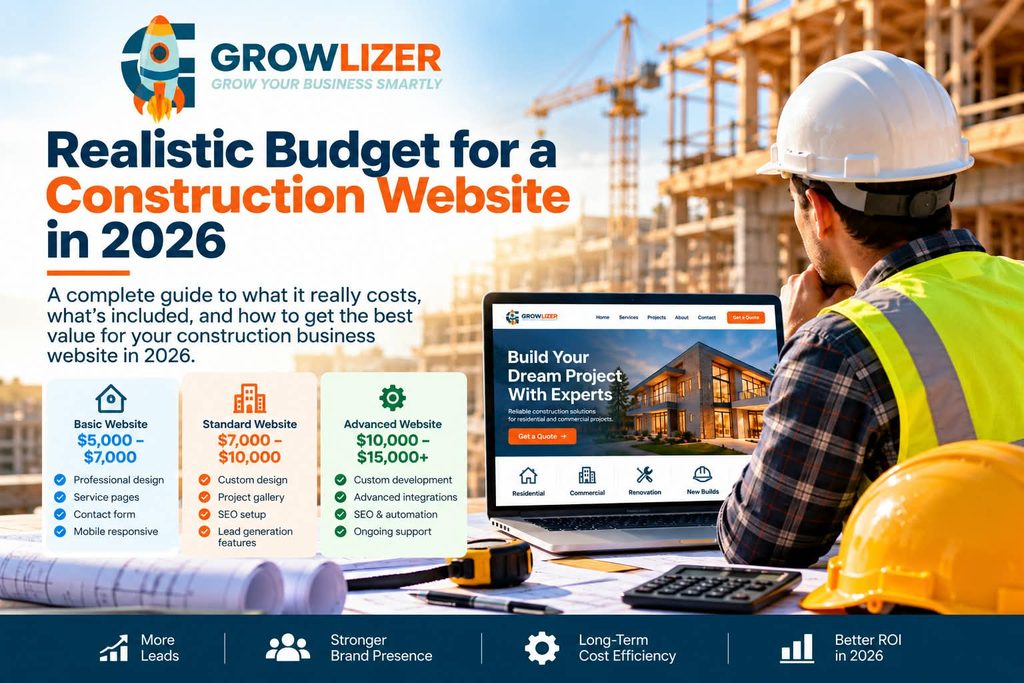
Realistic Budget for a Construction Website in 2026
A properly built construction website with the features above typically runs $5,000–$15,000 depending on portfolio size and integrations, with ongoing SEO and maintenance as a separate monthly investment. Companies that treat SEO as a 12–18 month investment, rather than expecting instant results, consistently end up with a lower long-term cost-per-lead than those relying solely on paid ads.
Final Thought
The construction companies pulling ahead in 2026 aren’t necessarily doing more marketing — they’re converting more of the traffic they already have, through faster load times, faster lead response, and a site built around how contractors actually get chosen.
Growlizer builds high-converting websites for US construction and contracting companies, with SEO and AI-powered lead follow-up built in from day one. Want a free audit of your current site’s conversion gaps?
