
Clinic & Dental Website Development in the USA: Features That Convert Patients (2026)

Dental website development USA is becoming more important as patients increasingly search online before choosing a dentist or clinic. A modern dental website is no longer just an online brochure—it can help practices attract new patients, build trust, and turn website visitors into booked appointments. The dental and clinic market in the US is growing fast — but so is the number of patients who research providers online before ever picking up the phone. A modern clinic website isn’t a digital brochure anymore; it’s the first real interaction most patients have with your practice.
Why the Website Matters More Than Ever
The vast majority of patients now search online before booking an appointment, and most contact a provider directly after that search. Reviews and online reputation weigh heavily in that decision — most patients rely on online reviews as a key factor when choosing a provider, and a large share won’t consider a provider with too few reviews. In practice, this means your website and your Google Business Profile work together as your primary new-patient acquisition channel.
The Booking Gap Most Practices Haven’t Closed
Here’s a striking statistic: only around a quarter of dental practices currently offer real online booking, even though the large majority of patients say they prefer it and want it as an option. Practices that add genuine online scheduling — not just a “call us” button — are capturing patients that competitors without it are quietly losing, particularly younger and busier patients who won’t call during business hours.

What a High-Converting Clinic Website Needs in 2026
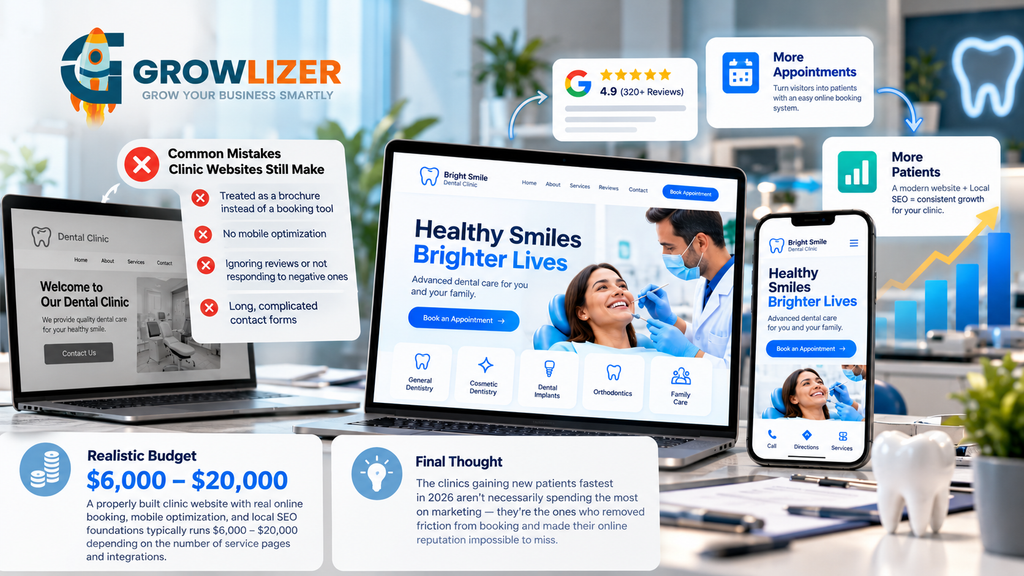
A successful dental website development USA strategy should focus on more than attractive visuals. The website needs real online booking, mobile-first design, clear service pages, reviews, fast loading speeds, and secure patient forms.
1. Real online booking, not a contact form that requires a callback — patients want to see availability and book in one step
2. Mobile-first design — a large share of patients search for a provider on their phone, often after hours
3. Clear service pages for each major treatment area (general, cosmetic, orthodontic, implants, etc.) — patients research specific procedures before choosing a provider
4. Reviews prominently displayed, ideally pulled live from Google rather than hand-picked quotes
5. Fast load speed — patients researching providers on mobile abandon slow sites quickly, especially when comparing multiple options
6. HIPAA-conscious contact and intake forms — any form collecting health information needs to be handled with proper security, not a generic contact plugin
Patient Acquisition Cost Context
Acquisition cost varies enormously by channel and procedure type — referral-driven patients can cost as little as $25–$100 to acquire, while competitive procedures like implants driven through paid search can run $800–$2,000. What makes clinic marketing work long-term is patient lifetime value: even a general preventive patient is worth thousands of dollars over years of recurring visits, which is why a well-built website and consistent local SEO usually deliver a stronger return than heavy reliance on paid ads alone.

Local SEO Is the Highest-ROI Channel for Clinics
Because most patients search for a provider “near me” or in their specific city, ranking in Google’s local map pack is typically the single highest-leverage digital investment a clinic can make — it targets people who are already looking for care, rather than trying to create demand from nothing.
Automation That Actually Helps a Clinic
– Automated appointment reminders — reduces no-shows, one of the most costly recurring problems for any clinic
– AI-assisted booking follow-up — if a patient starts booking but doesn’t finish, a gentle automated follow-up recovers a meaningful share of those lost bookings
– Review request automation — asking satisfied patients for a Google review shortly after their visit, when the experience is still top of mind

Common Mistakes Clinic Websites Still Make
– Treating the website as a brochure instead of a booking tool
– No mobile optimization, despite most searches happening on mobile
– Ignoring reviews entirely, or not responding to negative ones (which patients notice)
– Long, complicated contact forms instead of a fast, simple booking flow
Realistic Budget
A properly built clinic website with real online booking, mobile optimization, and local SEO foundations typically runs $6,000–$20,000 depending on the number of service pages and integrations (booking software, patient portal, payment processing).
Final Thought
The clinics gaining new patients fastest in 2026 aren’t necessarily spending the most on marketing — they’re the ones who removed friction from booking and made their online reputation impossible to miss.
Growlizer builds HIPAA-conscious, booking-enabled websites for US clinics and dental practices, with local SEO and automated patient follow-up built in. Want a free review of where your current site is losing patients?